— Materials
Three surfaces · one studio
Every material we work in is applied over a substrate we've prepared ourselves — set out, primed and made true before a finish coat goes near it. It's the part no one sees, and the part that decides whether the surface lasts.
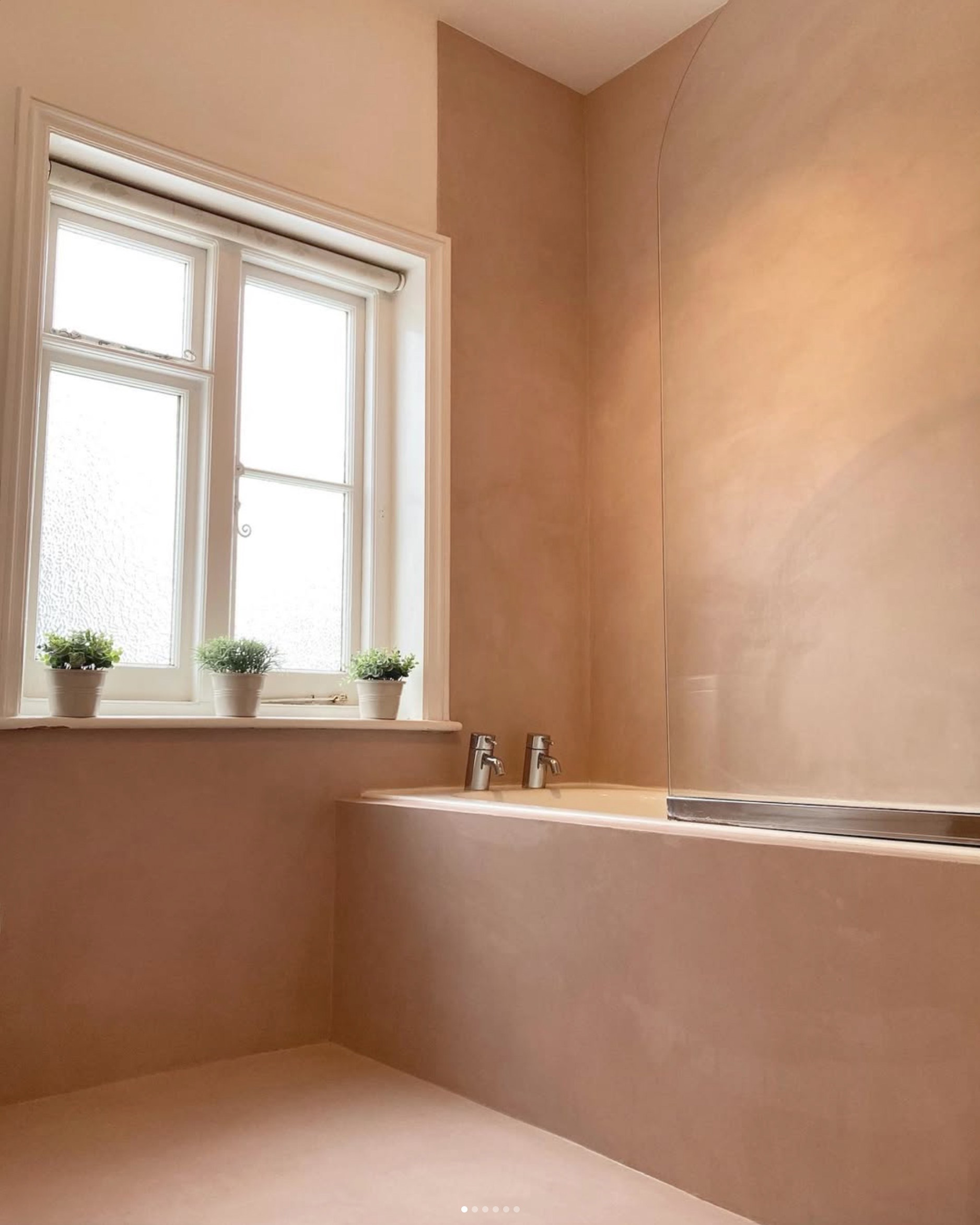
Its natural water-resistance made it the finish of choice for spaces where water and walls meet.
The material is shipped to us in its raw state — a fine paste of crushed Moroccan lime — which we mix on-site with the approved colour. Pigments are added either as powdered earth oxides or as inks, depending on the depth of tone and the finish required.
What follows is a process that cannot be rushed. We begin with our base coat work, drawing on a deep foundation in traditional plastering: a finish is only as good as the wall beneath it. Once the base is solid and true, the Tadelakt itself goes on in three coats.
The first coat is laid and left to dry completely. We watch it as it cures — feeling for the moment when it has pulled in enough that the surface no longer transfers to the hand, but still holds moisture beneath. The second and third coats are applied on the same day, one after the other, each timed to the precise moisture state of the last.
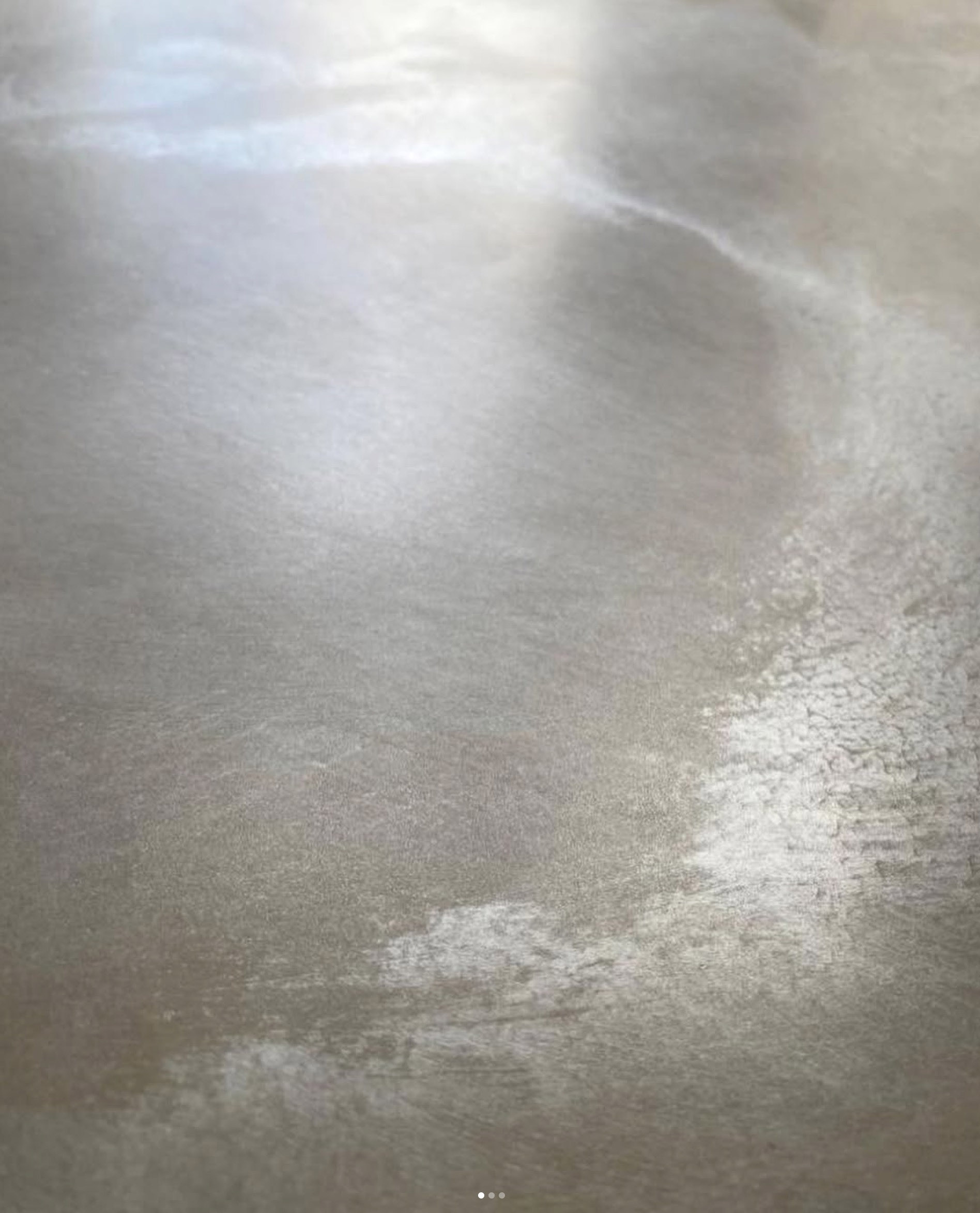
When the final coat begins to firm, we compress it with the trowel. This is where Tadelakt becomes Tadelakt — the compression binds every layer into one, drawing the lime tight against itself and forming the dense, polished surface that gives the material its character.
After the wall has dried, we apply a traditional Moroccan soap, which calcifies into the surface and triggers a slow chemical reaction with the lime — sealing the plaster from within and producing its natural water-resistance. A final wax layer adds durability and makes the surface easier to maintain.
Tadelakt is a living finish. It is meant to be touched, used, and re-soaped occasionally to keep it at its best — and the patina it develops over the years is part of the pleasure of owning it.
What started as imitation became its own discipline — a defining surface of European interiors for over five hundred years.
The material is a precise blend of crushed marble and slaked lime. Once mixed, applied and compressed, it undergoes a quiet transformation: the lime carbonates as it cures, and the surface chemically returns to stone. That is the principle that makes Marmorino so enduring — it isn't a coating laid over a wall. It becomes the wall.
Like Tadelakt, the work begins with the substrate. We prepare and prime the wall to ensure a sound, even base, then build up our base coats in the technique appropriate to the project. The Marmorino itself is applied in successive thin layers, each compressed firmly with the trowel before the next is laid.
The number of coats and the degree of polishing depend entirely on the finish required. A matt Marmorino — softer, more textural — needs fewer passes. A high-polish finish, where the surface gleams and reflects light like cut stone, can demand five, six, or more layers, each worked harder than the last. The final compression with a clean steel trowel is where the marble within the plaster reveals itself: depth, movement, and the unmistakable cool gleam of polished stone.
Marmorino can be tinted to almost any colour — pigments are mixed through the body of the material, so the colour runs the full depth of the finish rather than sitting on the surface. It works equally well in heritage restoration and in clean contemporary architecture, and like all lime-based plasters, it ages with grace.
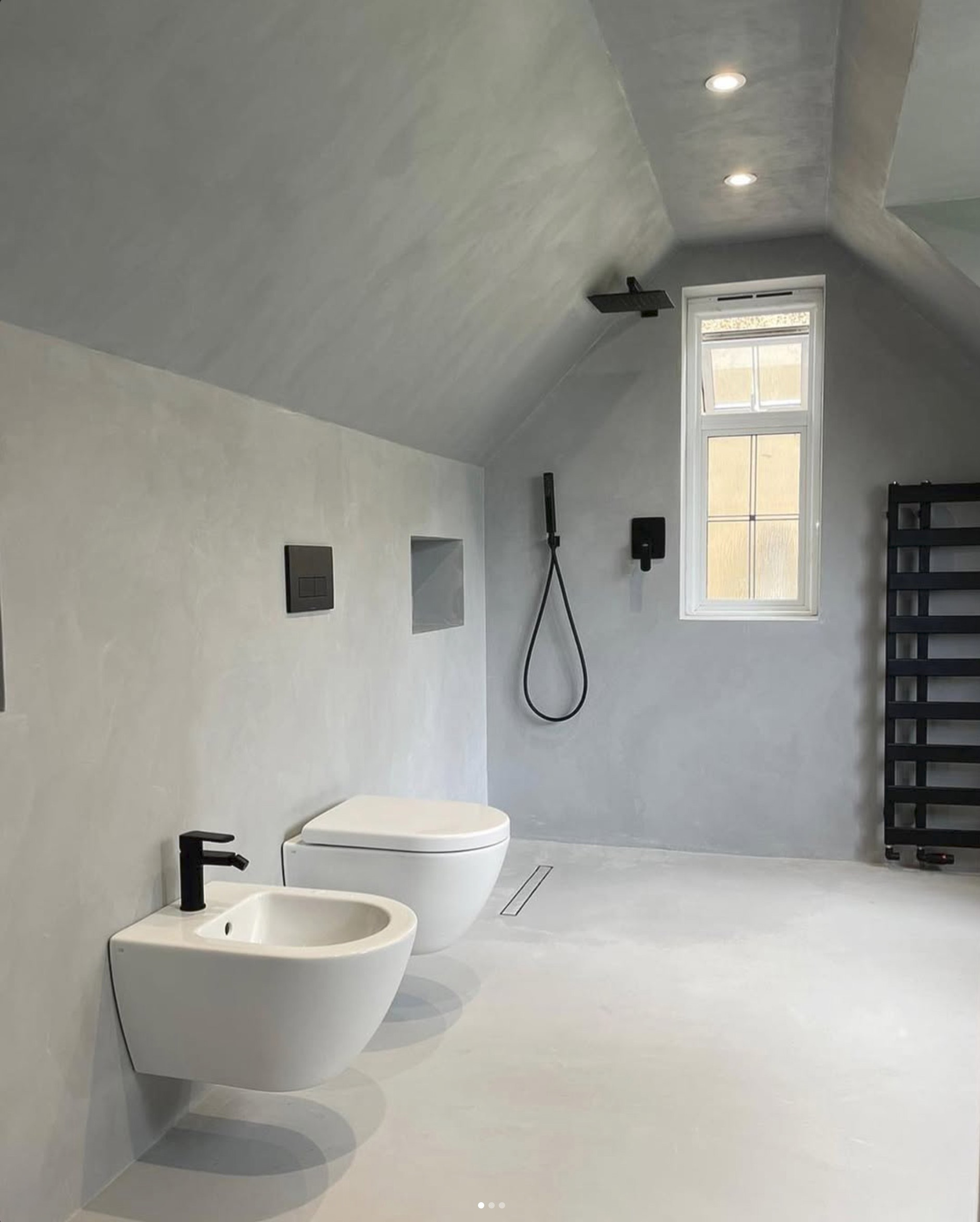
Where the lime plasters draw on centuries of tradition, micro cement is a product of contemporary chemistry: resin-based, fully waterproof, seamless.
It can run across walls, floors, kitchen worktops, vanities, bath surrounds and bespoke joinery. The application is deceptively complex: there are seven distinct layers in a complete system, each playing a specific structural or aesthetic role — and it all comes to a finished thickness of around three millimetres. There is no margin for error. The substrate has to be sound, the timing between layers right, and every coat applied with consistency, because every coat affects the one above it.
Preparation is everything. We begin with a primer specific to the substrate, followed by a fibreglass mesh embedded in the first layer to control any movement in the material below. The base coats are then built up to provide structure and start shaping the colour. The finish coats, applied last, are where the surface character is dialled in — the trowel marks, the cloudiness, the depth of colour, the degree of mottling. Once cured, the surface is sealed with a series of waterproofing treatments that lock the resin matrix.
The result is a continuous, stone-like surface with no joints, no grout lines, no breaks. It can flow from a bedroom into an ensuite, wrap a freestanding bath, climb a staircase wall, and continue out into a courtyard — holding a single tone and texture across every surface it touches. Hard-wearing enough for commercial floors, refined enough for the most considered private homes.
Micro cement is where lead times matter most. Because of the seven-layer build and the careful timing each layer demands, a typical project requires a minimum of eight weeks' notice, with site preparation and access coordinated with the rest of the build programme. We work closely with builders and project managers from the outset, so the surface that gets installed is the surface the architect drew.